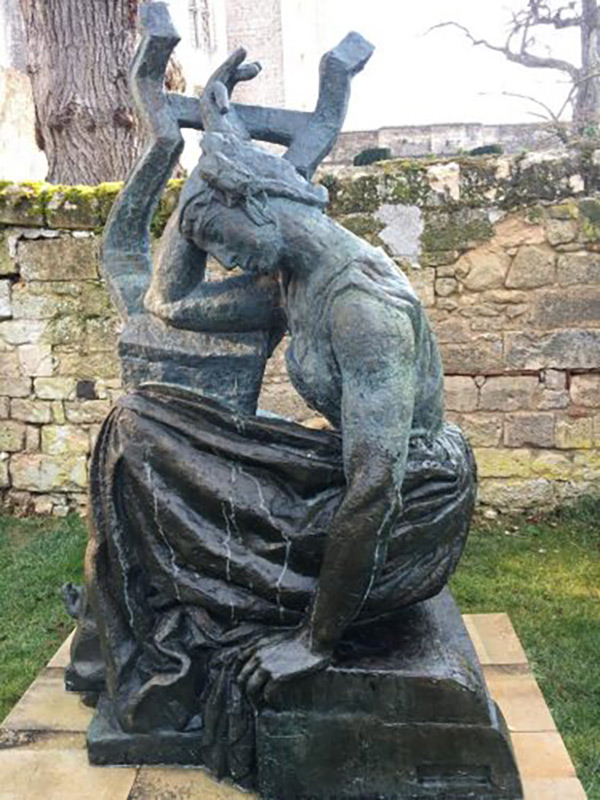
At the heart of the Donjon de Vez apple orchard sits a remarkable work by Antoine Bourdelle: Sapho. This natural setting, conceived as a showcase, magnifies the poetry of this sculpture, while underlining the subtle dialogue between art and nature.
Sapho: harmony between art and nature by Bourdelle
A theme revisited by Bourdelle
Inspired as early as 1887 by a young Italian woman, Bourdelle gave Sapho its definitive form in 1925. Presented at the Exposition Internationale des Arts Décoratifs, the work reflects Bourdelle’s quest for simplicity and monumentality, in reaction to sculpture deemed too expressive.
An aesthetic between archaism and modernity
An aesthetic between archaism and modernity
Sitting in meditation, Sapho holds a schematized lyre with Cubist overtones. The geometric shapes, the angular folds of her dress and the triangular composition give the work a timeless force, oscillating between archaism and abstraction.
Monumentalism in the 1920s
With Sapho, Bourdelle infuses an intimate scene with a monumental character. His refined, geometric style illustrates the 1920s quest for balance, combining sobriety and expressive power.