In 1989, internationally renowned master landscape gardener Pascal Cribier and Patrick Ecoutin designed a unique minimalist garden for the main courtyard of the Donjon de Vez. This contemporary project, classified as a “Remarkable Garden” by the French Ministry of Culture, elegantly revisits the codes of medieval gardens while integrating a contemporary vision.
Minimalist garden: a dialogue between nature and history
A reinterpretation of medieval gardens
Inspired by the walled garden tradition of the Middle Ages, Cribier revisits the geometric forms emblematic of that era, notably quatrefoils. These plant motifs, mixed with stone quatrefoils, create a symbiosis between living and mineral architecture. Variations in levels and shortcuts in perspective evoke an era when depth was suggested by the interplay of volumes rather than the laws of perspective.
A tribute to medieval tapestries
In the center of the garden, bouquets of gaura recall the famous “thousand-flower” tapestries, adding a poetic touch that changes with the seasons. The box hedges, deliberately lower when they arrive than when they leave, amplify the effect of concentration and contemplation.
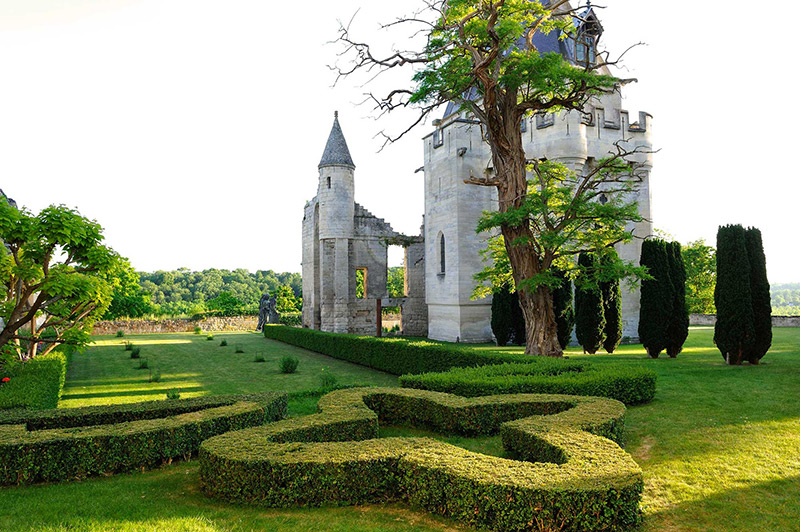
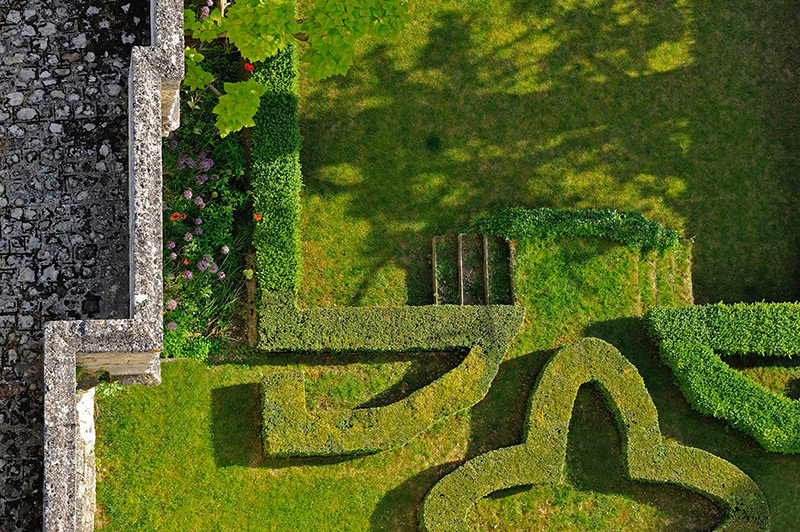
Minimalist garden: a dialogue between nature and history
Water, light and symbolism
A water mirror, placed at the foot of the chapel, reflects the ruins of the fortified dwelling and extends the majesty of the site in a play of light and reflections. Surrounded by a bed of blue irises, the symbol of French royalty, it anchors the garden in a historical tradition, while offering a palette that explodes with the seasons: black and yellow tulips, flax bouquets and iris sibirica.